Monday, May 8, 2017
What a difference a week makes
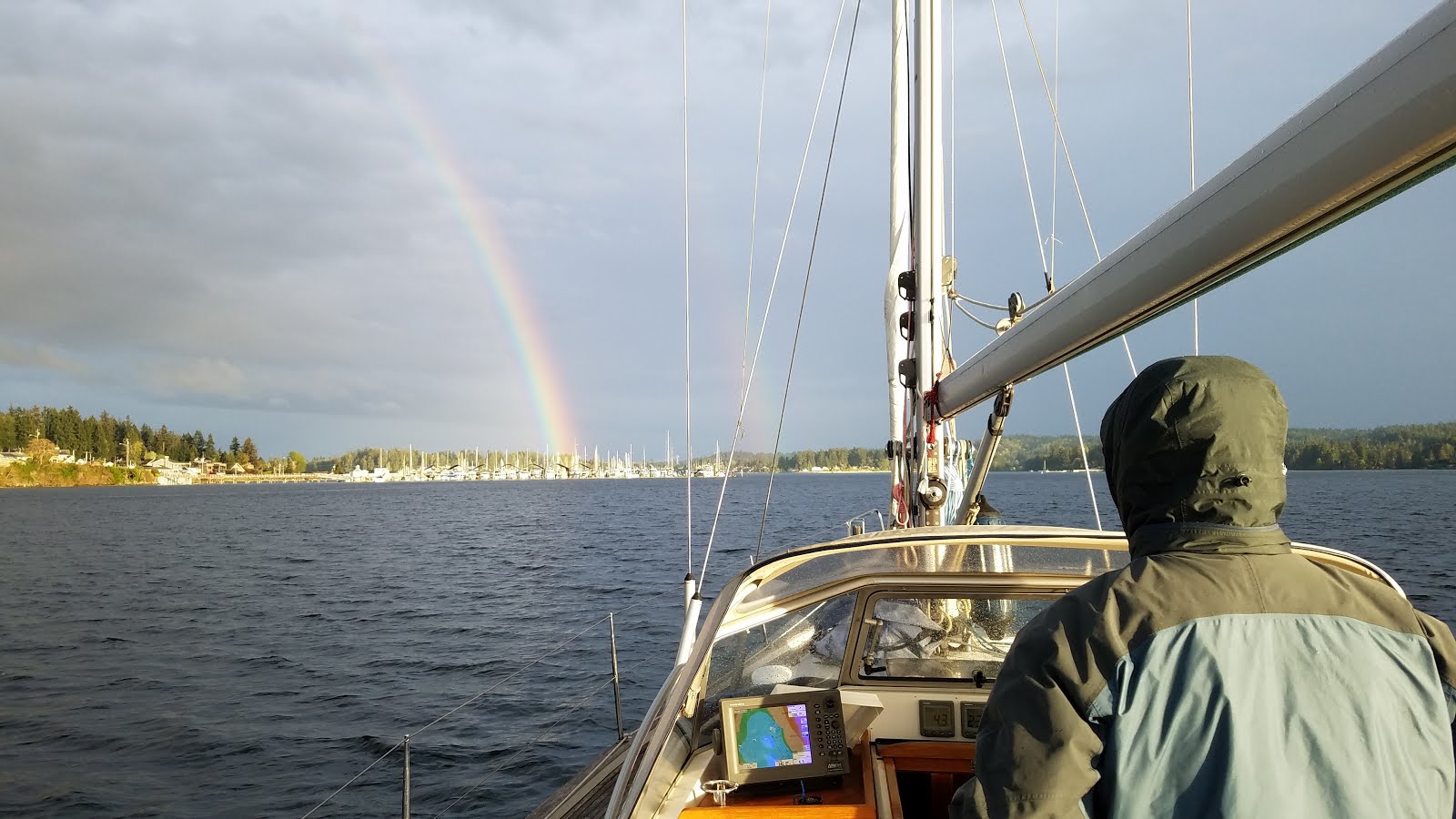
Yesterday was the official opening day of boating season, so today boats were streaming through the locks. I counted 33 boats in the lock with us as we were lowered from the level of Lake Union to Puget Sound. Compare that to last weekend when we were the only boat in the lock. All proceeded in an orderly fashion though and we squirted out into the sound a mere hour and a half after leaving the dock - not bad, considering the stampede.
The day’s travel northward was relatively uneventful. With no main sail and wind out of the north, we didn’t have an opportunity to do any sailing, but it was a lovely day and the spinnakers were out in force. It’s Sunday night in Port Townsend. so moorage is plentiful. Dinner in town was followed by hot showers and a look at tomorrow’s charts. We’ll start the day at the sail loft where we’ll pick up a couple new sails, detailed in a previous post, and then head north into Canadian waters.
Monday, May 1, 2017
The Final Shakedown
The latest blog has morphed from one that was intended to be used between trips into one that will be used for the upcoming trip, essentially leaving the details about the maintenance that has been going on in the blog rather than starting up a new one.
Last weekend several of us launched out to put Quijote and a few of the crew through their paces, a shakedown cruise if you will. It turned out to be a great time, as is most often the case when we venture out onto the water.
We started off with a minor crisis when, no sooner had we requested the Ballard bridge be opened than the engine temperature alarm started wailing. We shut the engine down and drifted for a while to let the engine cool while we investigated the source of the problem. Several weeks ago I found that the previous owner had used the wrong kind of coolant in the engine, so I drained and refilled it with distilled water, warmed it up, then repeated the process a couple of times to get most of the old coolant out, before filling it up again. Going though all this, I noticed that more coolant was drained than it was taking to refill, so I was sensitive to the fact that there might not be enough coolant in the engine. After the engine cooled I pulled the coolant cap off and found that it was indeed dry, so it was just a matter of adding more as coolant worked its way into the nooks and crannies.
With that problem resolved, we headed out the locks. We actually had the lock to ourself for the first time that I can remember.
The first order of business once we had poked our nose out into the sound was to test the water-maker. It was inoperable when I first fired it up many months ago, and it took several weeks of troubleshooting, ordering and replacing various parts as one problem and then another was fixed. I finally got it to a state where I was confident that it was working properly, but sitting in a clean freshwater lake, as Lake Union is, didn’t allow me to test it fully.
For the first time had the opportunity to actually make fresh water out of seawater and I’m happy to report that it works like a champ! I installed a sample valve while I was working on it that allows me to divert the flow to a tasting cup before sending the desalinated water to the fresh water tanks. When I diverted the water into a cup and tasted it, it was wonderful. Ain't technology amazing!
We followed our footsteps of last year’s preparation cruise and headed around the south end of Bainbridge Island and up into Liberty Bay. The weather was a little dodgy, but at least it wasn’t raining. It took us a couple of tries to get ourselves docked after getting kicked out of the first place we tried, but we were finally able to step off the boat and wander around Paulsbo for a while. When we made our way back to the boat intending to head out into the bay for a little anchor practice, we found the winds had kicked up enough that getting out of the slip had me a little worried. I pictured getting blown sideways in 25 kts wind with no flow over the rudder to give me any control. It probably wouldn’t have been a problem, but the crew was happy to wait it out and when the winds finally gave us a lull, we jumped at the dock lines and charged out of there.
We were glad we did. Even with the winds snorting again, it is always more quiet in an anchorage than it is in a marina. It is also the case that boat naturally points its bow into the wind when at anchor, so the cockpit stays relatively dry behind the dodger. That’s not the case when tied to a dock. So it was a good decision. The anchoring was well done by the crew and we enjoyed a terrific meal before settling off to sleep with the weather raging around us.
The following morning we pushed out early to make slack water in Agate Passage, so we were back in town relatively early.
All in all it was a very successful weekend. We learned a few things and added items to our shopping lists that will be helpful to have when we make our departure next Sunday morning.
Quijote Crew makes their way home through the Ballard locks
Monday, February 27, 2017
New Sails
We have new sails to play with! Four in all. I had the main surveyed and it turns out it needed replacing. It could have been repaired, but it wouldn’t have been worthwhile. I’d have needed to replace it before heading across an ocean anyway.
I also needed storm sails. A storm jib and a storm trisail have been added to the inventory. Both have florescent visibility patches. I still need to add some deck hardware for the trisail sheets and a new trisail halyard which will double as a spare topping lift, but the storm jib had a new halyard added around this time last year. It gets hanked on to a solent stay, also added last year, that will allow the genoa to be furled when the storm jib is in use. The solent stay is a temporary inner forestay that is anchored to the deck just abaft of the forestay the genoa furls around. When the solent stay is not in use it is disconnected from the foredeck and anchored to the mast.
Lastly, I’ve added a drifter to the sail inventory. The drifter is a light air sail that will allow us to sail up wind where the asymmetrical spinnaker is for down wind use. Both are made out of colored nylon and both have their own continuous loop furler. The spinnaker tack is anchored to a removable bowsprit and the drifter is anchored to the pad eye used for the solent stay.
For more information on drifters, Carol Hasse’s article is well worth reading:
http://www.porttownsendsails.com/pdf/light_air_sails.pdf
Sunday, February 5, 2017
The Procrastinating Swimmer
Quijote is a little gimpy at the moment. Looking into the question of when I need to change the engine coolant, I discovered that the engine had the wrong kind of coolant in it. It shouldn’t be a big problem, but it is certainly worth changing it out, since the coolant is several years old anyway. I drained the old coolant and filled the engine with distilled water. Then I started the engine, intending to warm it up and let it circulate before draining it again. Unfortunately when I did that, I discovered that with the engine running there was no water coming out of the exhaust. That’s usually an indicator that the sea water impeller is damaged. When I opened the pump, though, there was nothing wrong with the impeller. Hmmm….
The next step was to remove the hose from the water inlet valve (after closing the valve) and put the hose in a bucket of water. Then I started the engine and watched the engine suck water out of the bucket. That tells me there is nothing wrong with the engine, that the sea water inlet is obstructed.
I was imagining a large build up of barnacles and other unfettered sea growth, but reading a book on boat maintenance, the author says it is very common for the sea water inlet to be clogged with plastic bags that float around in the water. In any case I won’t know until I can dive under the boat and have a look.
The temperatures over the last couple of weeks have not encouraged me to be very diving adventurous, however, so I’ve been giving the weather some time to warm up. I’m also giving some serous thought to buying a scuba tank that will give me time under the boat for a more thorough examination of the condition of the hull, the paint, and the various anodes used to fight corrosion. Depending on what is learned, I might still want to haul the boat out of the water to have the bottom painted, the anodes replaced, or repair any other problems I find. The boat is in fresh water, so I don't expect to see much in the way of all that, but you never know.
Or I'll pay someone to take a look and spare myself the swim. There is something about going for a swim in 35˚ weather that just doesn't motivate me, wetsuit or not.
Friday, January 6, 2017
Identification
I’ve been somewhat focused on AIS this month. I’m the proud new owner of the venerable XB-8000 transponder. That’ll get the ladies’ loins a stirrin’ But let’s not forget the Vesper antenna splitter. That’ll take ‘em right over the edge.
AIS transmits a boat’s position, speed, name etc to anyone else who has AIS. Most boats do by now, so we can all see each other on our plotters.
The antenna spitter taps into the vhf radio antenna. Easy. Power and data were a little more challenging. Installing an AIS transponder is a great opportunity to get to know your boat. You have to figure out how best to apply power and push the data cables through the bundles of existing cables. You have to figure out what you’ve got, to know what get’s connected where. Profound stuff.
I got it working using a temporary gps antenna. The unit transmits and receives. I can pull up an app on my ipod and see a display of the targets received nearby. The next step is to tap into the boat’s data bus by reading its gps and displaying the targets on the plotter. It’s all standard format data so it should work...
Monday, December 19, 2016
Bilge Business
I’m reading a book called "The Voyager’s Handbook" by Beth Leonard. It’s a extremely thorough collection of all the stuff you need to know about offshore cruising aboard a sailboat. Somewhere near the beginning; after crew considerations, choosing and financing your boat, and before sails and sail handling is a chapter on upgrading the boat for offshore. Therein is a recommendation to have a manual bilge pump below deck that will pump at least thirty gallons per minute. This is in addition to an automatic (DC powered) bilge pump. There are good reasons to have a manual bilge pump below deck: it will work when all power is lost, it will be out of the elements, and it can be within reach of the VHF radio at the nav station.
Quijote has an automatic bilge pump that will pull water out of the bilge at 67 gallons per minute. She also has a 20 gallon/minute manual bilge pump in the cockpit where a single hander will be able to steer and pump at the same time. Those two pumps mostly meet the book's recommendations. While the manual pump is out in the elements and puts out less than the recommended thirty gallons/minute, it is in reach of the wired VHF remote at the helm. Still, I began to consider supplementing the manual throughput by adding a second manual bilge pump below deck.
I was loathe to be adding any additional through-hull valves for that purpose, but what if I tee’d into the existing bilge pump plumbing. To that end, I spent the better part of a day investigating the feasibility of adding a second manual bilge pump. I looked into making room for a new hose that follows the existing manual pump plumbing and discovered very little additional room in some key constrictive places. I also found few places below deck that would not be awkward to operate or consume precious storage space.
It occurred to me after several hours of pondering and scrabbling about, that teeing into the existing manual pump plumbing is a dumb idea anyway. If I lose power and need to pump manually, I don’t want the choice of pumping in the cockpit or below deck; I want to be able to use both manual pumps if I can. That being the case, I want to be teeing into the automatic pump plumbing. As luck would have it, that turns out to be a much less invasive change, since the plumbing runs through a forward locker rather than squeezing between heating ducts and hot water hoses in the engine room as the existing manual pump plumbing does.
It also turns out that a twenty gallon manual pump is about a fifth of the cost of a thirty gallon pump and takes up a lot less space. If I buy a second identical 20 gallon pump that taps into the automatic pump’s plumbing, then the manual pumps are interchangeable, I need only one spare, and I get forty gallons per minute when the power is out. If the power is not out, I’ll have the 67 plus 20 gallons per minute I have now.
So that’s the plan. I still need to do a little research, maybe use a check valve or two to prevent back pressure from one pump to the other, but it is a change that should be relatively easy and affordable.
Subscribe to:
Posts (Atom)